
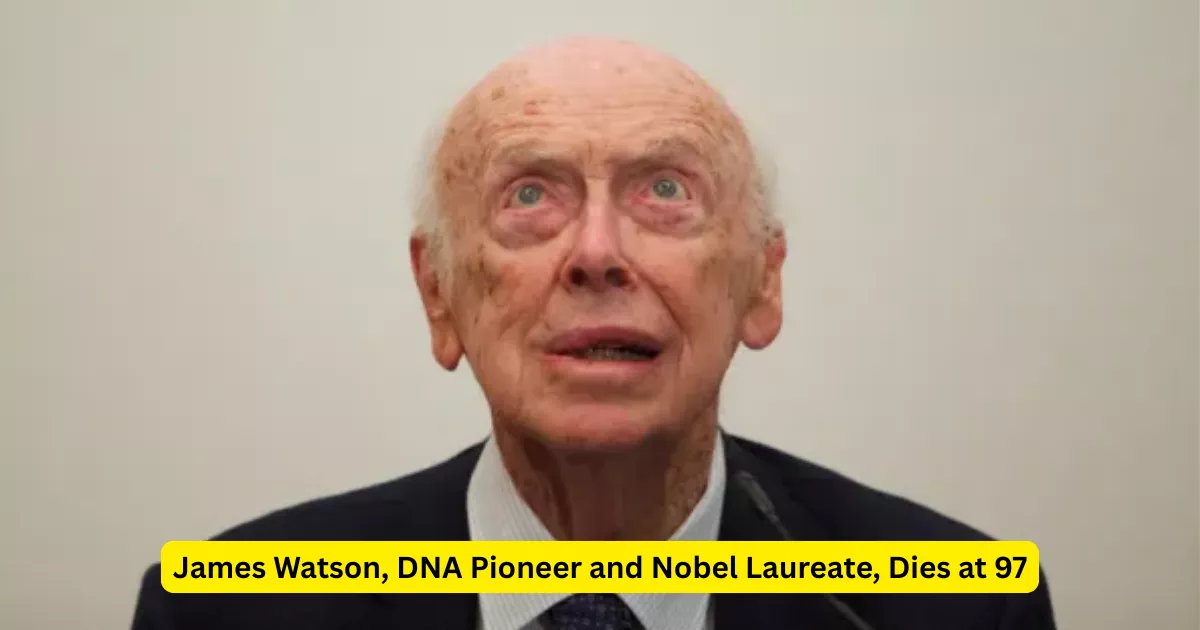
James Watson, a pioneering American scientist and Nobel Prize laureate who co-discovered the structure of DNA, has died at the age of 97.
Watson, along with British scientist Francis Crick, identified the double-helix structure of DNA in 1953, a landmark discovery that fueled rapid progress in molecular biology throughout the 20th century. He shared the 1962 Nobel Prize in Physiology or Medicine with Crick and Maurice Wilkins for this breakthrough.
Despite his scientific achievements, Watson’s legacy was marred by controversial remarks on race and intelligence. In a televised interview, he suggested genetic differences in average IQ between Black and white people a claim widely discredited and condemned. His comments led to his resignation as chancellor of Cold Spring Harbor Laboratory, where he had worked for decades. Further remarks in 2019 cost him honorary titles at the institution.
DNA itself was identified as the material carrying genetic information in 1943, with Watson and Crick constructing a physical model based in part on X-ray images by researcher Rosalind Franklin, whose pivotal contributions were long underrecognized. Maurice Wilkins, Franklin’s colleague, also played a key role in determining DNA’s structure.
Watson fostered female scientists’ careers at Harvard in the 1950s and 60s but also made sexist comments about Franklin, including on her appearance, notably in his 1968 bestseller The Double Helix. Later in life, he became the first living Nobel laureate to auction off his gold medal, fetching $4.8 million, though a Russian billionaire promptly returned it to him.
Born in Chicago in April 1928, Watson showed early academic promise, studying diffraction techniques and later pursuing DNA research at Cambridge University, where he met Crick. Afterward, he moved to Harvard as a biology professor. He and his wife Elizabeth had two sons, one diagnosed with schizophrenia, which motivated further DNA research for potential medical insights.
Watson led Cold Spring Harbor Laboratory from 1968, transforming it into a leading scientific research center. His death marks the loss of a towering yet controversial figure in modern science.